
Summary
While World War II is often taught through the lens of distant battlefields, the domestic war of mobilization was won through a landscape shaped millions of years prior. This presentation demonstrates how the Fall Line—the geomorphologic boundary between the Piedmont and the Coastal Plain—served as the primary spatial determinant for American mobilization in the 1940s.
By analyzing historical cartography and industrial density maps, we explore how the Fall Line’s “break-of-bulk” points evolved from 18th-century trading posts into the 20th century’s most vital logistics hubs. This session will provide educators with a framework for using primary sources, including maps, to show students that the locations of WWII-era munitions plants, shipyards, and embarkation points in cities like Richmond, Baltimore, and Philadelphia were not coincidental. They were the direct result of a geological transition that provided the hydropower, rail connectivity, and deep-water access necessary for total war. Attendees will leave with access to FREE high-quality resources from the National World War II Museum, including a lesson plan on the Arsenal of Democracy that uses primary sources to bridge the gap between physical geography and global conflict, proving that the road to Berlin and Tokyo began at the waterfalls of the Eastern Seaboard.
Session Focus
Secondary/High School | Human and Cultural Geography | U.S. History
Conference Room
Cullen
Meet the Presenter
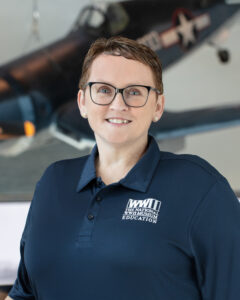 Josie Perry is a National Board certified teacher in Social Studies-History. She teaches US History, Contemporary World Studies, and Advanced Placement Human Geography at Rising Sun High School in Maryland. She is a Teaching Ambassador for the National World War II Museum and leads professional development sessions for the museum around the country. She was a co-host of the Museum’s Electronic Field Trip World War II: Legacy, which explored the end of the war and the postwar period, and a lesson contributor to the new Holocaust Curriculum Guide. She is a 2026 Auschwitz-Birkenau Memorial Foundation Fellow. In 2024, she completed a fellowship with the Genocide Education Project, including a field experience in Armenia and led multiple professional development sessions on the Armenian Genocide and its lasting impact. She has participated in the Choices Program Fellowship at Brown University with a focus on human rights, Fulbright Teachers for Global Classrooms Fellowship, the NEA Foundation Global Learning Fellowship, and the National World War II Museum Liberation and Legacy Fellowship.