NOVEMBER 16 – 20, 2026
Geography Awareness Week
“Mapping the Future”
Geography connects us to the people, places, and environments that shape our world. Join NCGE in celebrating the power of geography through engaging webinars, classroom resources, and opportunities to discover new ways of bringing geography into the classroom.
EXPLORE GEOGRAPHY AWARENESS WEEK
GEOGRAPHY AWARENESS WEEK SPECIAL
Explore NCGE Member Benefit on Us!
Experience a free seven-day trial of NCGE membership and discover what our educator community has to offer.
Featured Webinars
Explore new approaches and tools for bringing geographic thinking into teaching and learning.
Read More
Discover how National Geographic MapMaker can engage students through interactive maps, curated data, and 3D exploration. In this webinar, learn practical ways to incorporate MapMaker into science and social studies while building inquiry, geographic thinking, and spatial analysis skills. Explore standards-based activities and ready-to-use resources that help students investigate real-world issues and make meaningful connections to their world. No prior GIS experience required. (Presented by Esri with the National Geographic Society)
Read More
A webinar for anyone interested in…
- Geography as a lens for relevant learning
- Place-based, civic-minded teaching strategies
- Interdisciplinary project-based ideas
This interactive webinar will provide orientation and practical examples using an innovative teaching resource called CivicScape. CivicScape is a digital learning platform that builds place-based, standards-aligned lessons where students investigate real data from their communities—air quality, housing, health, and more—no data experience required. Gio, the platform’s built-in AI, adapts to teachers’ subject, location, and student needs to cut curriculum prep time, boost motivation, and generate map-based activities making any subject feel relevant to where students actually live. (Presented by trubel&co with the National Council for Geographic Education)
Featured Resources
Discover classroom activities, mapping tools, and teaching ideas that help students make connections between geography and the world around them.
A StoryMap and primary source inquiry lesson:
Mapping the Future of a New Nation
Learn about and explore for yourself the first map ever produced showing the existence of the United States of America. By examining and interpreting this historical document, you will better understand our country’s origin story and gain perspective on the power of maps as persuasive images. And then for comparison and validation, you’ll compare to a second map produced in the same era. In two maps, you will see two drastically different perspectives on the future ahead for the United States.
13 questions guide close map reading. Then the inquiry wraps up with 3 final questions that call on you to summarize what it all means.
A lesson on the future of water using MapMaker: Water – Is it REALLY running out?
What causes shortages in the water supply for cities and countries? Students will analyze and annotate a thematic map to draw conclusions about the causes of water risk in Mexico City.
A website with climate data and climate science explanations: Probable Futures
Probable Futures is a non-profit climate literacy initiative. We make climate science accessible and understandable so that everyone, everywhere can think about climate change in practical ways and prepare for what’s to come. The website has free data and information from highly reputable sources.
- Climate maps visualize past, present, and future climate change around the world.
- Climate handbook takes you from the climate stability of the past, through the changes we are experiencing today, and into our probable futures.
An article that reminds us geography education prepares students to shape the future:
What if Geography Is the Curriculum We Need for the Future?
This commentary from GAW 2025 is directly on point for this year’s theme of Mapping the Future. Author Demian Hommel, PhD, is an associate professor of teaching in Geography and Geospatial Science at Oregon State University and a faculty fellow with OSU’s Center for Teaching and Learning. His work focuses on human-environment geography, systems thinking and curriculum design for our collective future. He facilitates geography courses that integrate ethical AI use, community-building practices and digital storytelling.
Featured Open Access Articles:
Expand your geographic knowledge with research and articles that support geographic education and classroom practice.

Access the Full List
By Petteri Muukkonen & Ronja Aarnio (forthcoming)
By John C. Kostelnick, Jill Freund Thomas & Amy M. Bloom (Vol.23, No.3, 2026)
By Stephen Borders, Coastal Carolina University (Vol.23, No.2, 2026)
By Tom Patterson (Vol.23, No.1, 2026)
By Yolanda C. Lin, Chris S. Duvall, Carolyn J. Hushman & Anna C. Marklin (Vol.22, No.2, 2025)
By Tiani Wepener (Vol.22, No.2, 2025)
By Alida Cantor, Elizabeth Bartholomew, Kate Berry, James Blair, Dustin Mulvaney & Nancee Hunter (Vol.22, No.2, 2025)
By Hsiao-Ping Hsu (Vol.21, No.3, 2024)
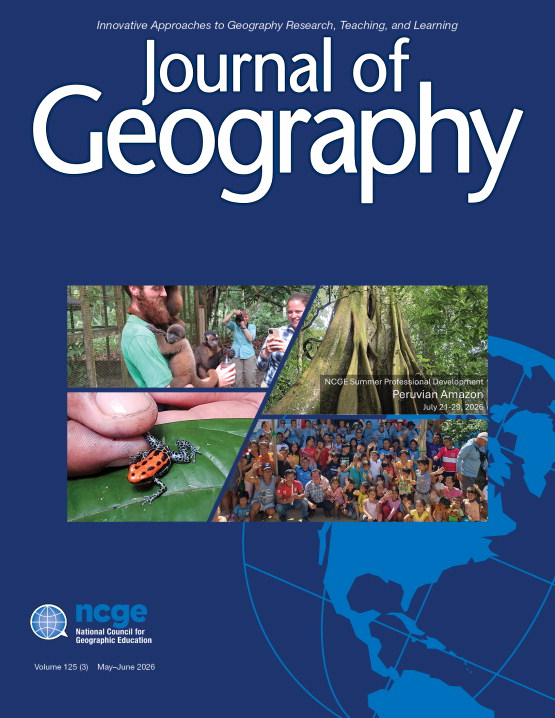
Access the Full List
By David Trokšiar, Lenka Krajňáková & Martin Hanus (forthcoming)
By John Morgan (Vol.125, No.4, 2026)
By Susan Caldis, Lauren Hammond, Kelly León, Nina Scholten & Tricia Seow (Vol.125, No.4, 2026)
By Lauren Hammond, William Quirke & Lucy Hunt (Vol.125, No.4, 2026)
By David Lambert, Sarah Witham Bednarz, Thomas Herman & Jerry T. Mitchell (Vol.125, No.4, 2026)
By Samantha M. Serrano (Vol.125, No.3, 2026)
By Eva Nöthen & Verena Schreiber (Vol.125, No.3, 2026)
By Petr Knecht, Michaela Spurná, Simon Catling & Petr Soukup (Vol.125, No.2, 2026)
By Daniel R. Wildcat & Timothy Schneider (Vol.124, No.6, 2025)
By Sarah Barger, et al. (Vol.124, No.3, 2025)
By Darryl Reano, Dominique David-Chavez, Kinsey Skillen, Kenneth Ridgway, Kyle Dahlin & Rylan Chong (Vol.124, No.3, 2025)